8 Ways to Keep Store and Online Support in Sync
Use eight evidence-led handoff fields to keep retail store, ecommerce and contact-center teams aligned without turning availability into a promise.
The short answer
Keep one shared order or case identity, the customer’s requested outcome, the exact store and current owner, timestamped inventory evidence, an explicit fulfillment state, and a separate record of what was promised. Assign the exception decision and next action, then close the loop in every active customer channel. Treat availability, routing and reservations as observations until physical fulfillment or pickup readiness is confirmed.
A customer who starts online and finishes in a store should not have to rebuild the case at every boundary. The receiving team needs the same order identity, the same requested outcome and a clear account of what is known now.
Retail systems can expose store-specific availability, route an order to a location, reserve quantity and move a pickup through transfer, ready and collected states. Those signals answer different questions, so support should not compress them into a single promise.3215
Use the eight fields below as one handoff record. Keep sensitive payment or identity material out of general notes, use the retailer’s authorized system and policy, and label every observation with its source and time.
2. Write the requested outcome and deadline
Describe the requested outcome in the customer’s terms: collect both items at one store, change the pickup person, receive a shipment by a date, or learn whether cancellation is available. Add the business reason or deadline only when the customer provided it.
Keep that request apart from the confirmed order state. Shopify’s pickup workflow uses customer notifications as the signal that an order is ready; the customer’s travel plan does not create that state.1
For covered delayed shipments, FTC guidance distinguishes the revised shipping date or an unknown date from the customer’s cancellation and refund options. Do not write a requested date as if it were a supported ship promise.6
Separate what the customer wants from what the retailer has confirmed.
- When it helps
- Use this before asking a store or fulfillment team to investigate or approve an exception.
- What to watch
- This adds one sentence to the handoff, but stops a preferred date or resolution from being mistaken for a commitment.
3. Name the exact store, location and current owner
Record the store code or exact location, the assigned fulfillment location, the team currently acting and the named next owner. If the order moved, retain the prior location and the transfer reason rather than overwriting the trail.
Google’s store-specific product guidance uses a store code to connect local availability, price, pickup information and store details. That makes location part of the evidence, not decorative metadata.3
A team name is not enough when the next action has a deadline. Give the receiving role or person, the action and the time by which it will update the shared record.
Make the physical location and accountable team unambiguous.
- When it helps
- Use this whenever stock, pickup, price, transfer or exception handling depends on a particular store or fulfillment location.
- What to watch
- Location-level detail takes more care than saying “the store,” but prevents the wrong site from confirming another location’s evidence.
4. Timestamp inventory, reservation and price evidence
Record the source system, store or fulfillment location, quantity, availability label, reservation state, relevant price and observation time. If two systems disagree, retain both readings and route the discrepancy instead of choosing the more convenient one.
Salesforce describes near-real-time location availability and reservations across channels, while also stating that its inventory capability does not replace ERP or warehouse systems and does not calculate estimated delivery dates.5
Google requires store-specific landing information to match submitted local data. Support should apply the same discipline: identify the store and source, then recheck before turning an observation into customer guidance.3
Show which system and location produced each observation.
- When it helps
- Use this when a customer or team sees a different quantity, price or availability state in another channel.
- What to watch
- Timestamped evidence can become stale quickly, but its limits are visible; an undated quantity can quietly become a false promise.
5. Use an explicit fulfillment state
Describe the current state as awaiting fulfillment, transfer required, split across locations, ready for pickup, shipped, picked up, cancelled or exception pending. Keep the original system label beside the plain-language explanation.
Shopify’s pickup workflow distinguishes transfer required, ready for pickup and picked up. Its fulfillment-location guidance also explains that routing can split an order or oversell when one location cannot fulfill every line.12
Do not say an item is held because it was routed, ready because it was reserved, or complete because one line was picked. Each state needs its own current evidence.
Keep routing, transfer, picking, readiness and completion distinct.
- When it helps
- Use this when an item appears available but the order has not reached the state the customer needs.
- What to watch
- Specific states add operational vocabulary, but they stop availability or routing from being presented as physical completion.
6. Separate the current fact from the customer promise
Write three short lines: what the system shows now, what the customer was told, and what the retailer can currently confirm. Mark timing as confirmed, revised or unknown.
FTC guidance requires sellers to have a reasonable basis for stated shipping time and to provide an appropriate delay notice when shipment cannot occur as promised. The handoff should therefore preserve both the old communication and the current delay fact.6
Do not turn near-real-time inventory into an arrival estimate. When a date is not confirmed, say who is checking it and when the customer will hear again.5
Keep observed evidence, prior communication and confirmed commitments in different fields.
- When it helps
- Use this when a prior message, storefront display or estimated date no longer matches the current order state.
- What to watch
- The distinction can expose a service gap, but gives the next team the information needed to correct it without repeating the promise.
7. Assign the exception decision and next action
For each open point, name the person or role deciding it, the evidence still needed, the next action and a specific update time. Separate operational work from the person authorized to approve a price, refund or policy exception.
A shared customer order can span store pickup and shipping, while routing can distribute fulfillment across locations. Ownership should follow the unresolved decision rather than assuming the originating channel can complete every action.42
A check-back time is a promise to update, not a promise that stock, transfer, shipment or exception approval will be complete by then.
Give every unresolved point an owner, evidence need and check-back time.
- When it helps
- Use this when a split, transfer, policy exception, delay or system mismatch still needs a decision.
- What to watch
- A named update commitment creates work for the owner, but prevents the case from circulating without a decision maker.
8. Close the loop in every active channel
Update the shared case or order timeline, notify the receiving team, send the appropriate customer message and record the final state. If a notification fails, keep the case open with a new owner for that communication task.
Shopify’s pickup process includes customer notifications and an order timeline, including the ability to resend pickup information. Those controls illustrate why the internal state and customer-facing message must be reconciled.1
Do not call a handoff complete merely because a note was sent. Completion means the receiving owner accepted the action and the customer-facing record reflects the supported outcome.
Make the order timeline, receiving team and customer-facing message agree.
- When it helps
- Use this after a store confirms a pick, a transfer changes the plan, an exception is decided or the request is closed.
- What to watch
- Updating more than one channel takes time, but avoids the next contact reopening an issue from an obsolete message.
Putting it into practice
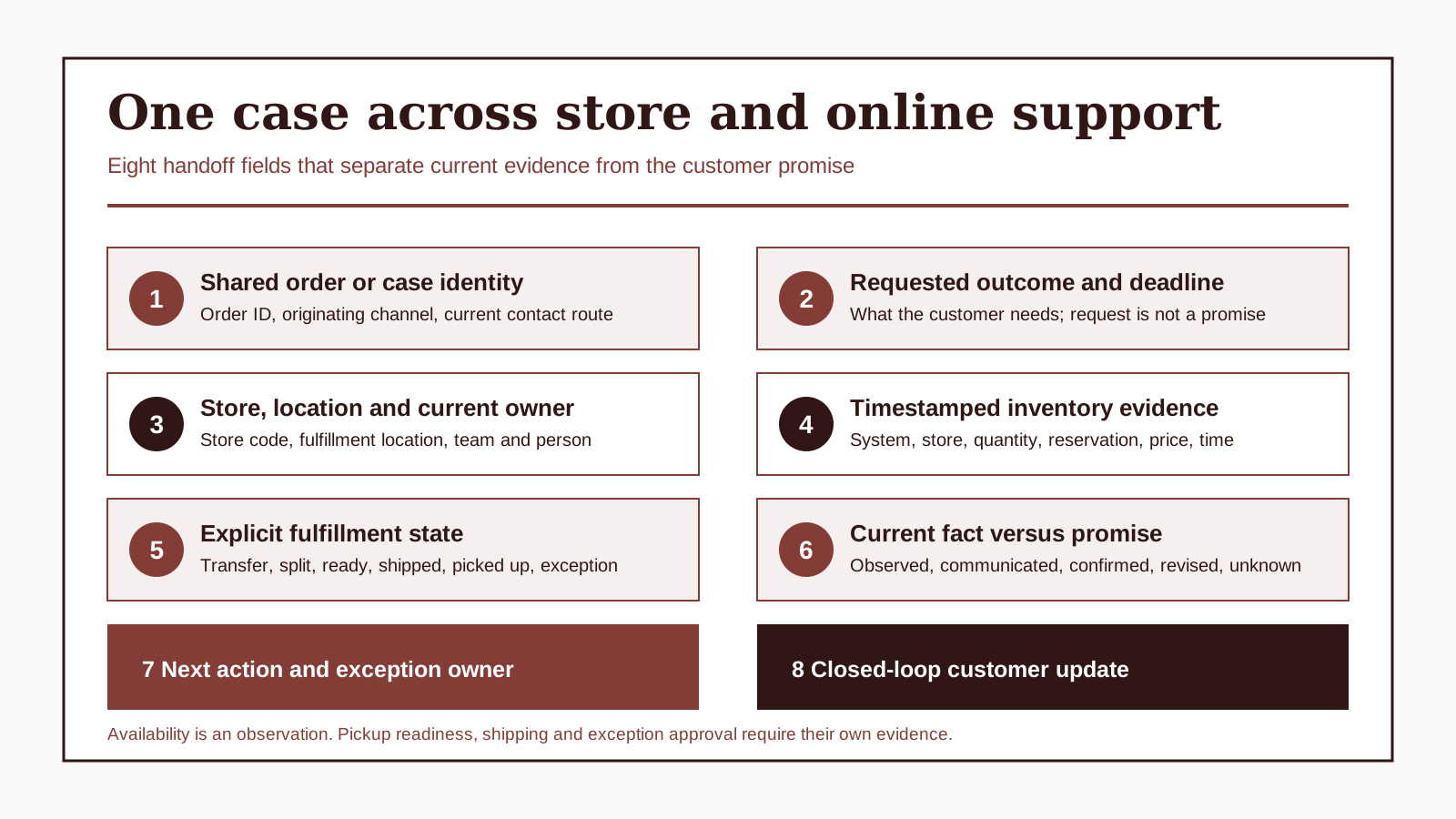
A reliable retail handoff is a compact evidence record: shared identity, requested outcome, exact location, timestamped availability, fulfillment state, customer promise, next owner and closed-loop update.
Keep those fields together whenever the channel changes. Retail Support Review’s guide index will collect more reviewed store-to-online service workflows.
How this guide was researched
Prepared from approved S011-L01 research and six current official Shopify, Google Merchant Center, Microsoft Learn, Salesforce Trailhead and Federal Trade Commission sources checked on 5 November 2026. Platform-specific states are labelled and bounded. The eight-field handoff protocol, decision table, fictional store-pickup example and SVG are original editorial work. No retailer, order, customer, payment or identity data was accessed. Current Ahrefs keyword and SERP calls attributed zero units because the connected workspace had no units left; the historical US volume 100 remains recorded while difficulty and parent topic remain unknown. Independent factual, source, editorial, product, originality, accessibility, SEO, asset-binding and responsive desktop/mobile visual review passed for this exact draft; publisher/legal, site, deployment and live gates remain separate and pending.
An eight-field store-online handoff protocol that separates shared identity, requested outcome, location, timestamped inventory evidence, fulfillment state, customer promise, exception ownership and closed-loop notification.
Editorial standardsSources
- Setting up pickup in store for online orders
Checked 5 November 2026 · Transfer-required, ready-for-pickup and picked-up states, customer notifications and the order timeline.
- Setting up locations for order fulfillment
Checked 5 November 2026 · Inventory-aware order routing, split fulfillment and oversell conditions across locations.
- Store-specific product pages with in-store availability and price
Checked 5 November 2026 · Store-code binding for local availability, price, pickup information and matching store-specific data.
- Customer orders in point of sale
Checked 5 November 2026 · Omnichannel customer orders managed through point of sale across pickup and shipping scenarios.
- Get Started with Omnichannel Inventory
Checked 5 November 2026 · Near-real-time location inventory and reservations, plus stated boundaries around ERP, warehouse and delivery-date functions.
- Business Guide to the FTC's Mail, Internet, or Telephone Order Merchandise Rule
Checked 5 November 2026 · Reasonable basis for shipping representations and delay notices with revised or unknown dates and applicable cancellation or refund choices.